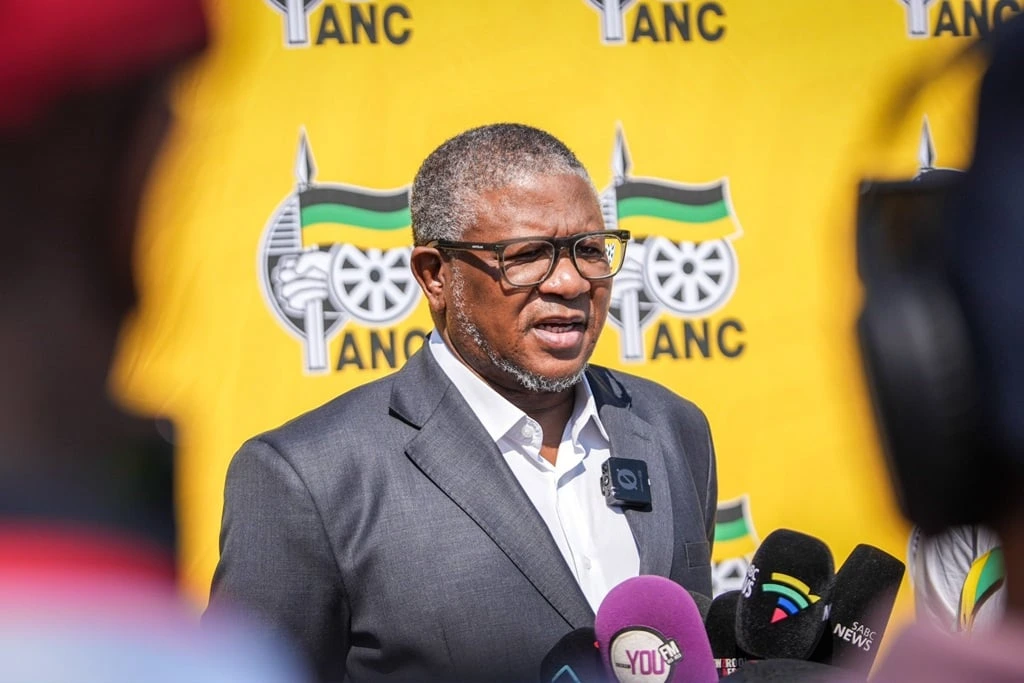
Fikile Mbalula is facing one of the biggest political tests of his time as ANC secretary-general.
What began as a dispute over candidate nominations ahead of South Africa’s November 4 local government elections is now threatening to become something much bigger: a test of whether the ANC’s current leadership can survive another major political setback.
Mbalula has rejected calls for him to step down over the party’s candidate-list crisis, insisting that any decision about his future rests with the ANC itself.
But the pressure on him comes at a particularly dangerous time.
The ANC is heading into an election that Mbalula himself has described as crucial to the future of the party’s leadership. After losing its outright majority nationally in 2024 and falling below 50% in the 2021 local government elections, another poor result in November could intensify internal demands for change ahead of the ANC’s next leadership contest.
The question is no longer simply whether the ANC can fix its candidate-list problems.
The bigger question is whether those problems become the first spark of a wider leadership revolt.
The crisis: 181 candidates caught in a dispute
The immediate dispute centres on 181 ANC candidates across six municipalities.
The affected candidates include 130 proportional representation candidates and 51 ward candidates.
The municipalities affected are Ingquza Hill, Port St Johns, Walter Sisulu and Sundays River Valley in the Eastern Cape, uMshwathi in KwaZulu-Natal and Mangaung in the Free State.
The ANC says the information for these candidates had already been entered into the Electoral Commission of South Africa’s electronic nomination system before the August 28 deadline.
However, the party says its administrators experienced technical difficulties before they could complete the final submission process.
According to Mbalula, the dispute is not about adding new candidates after the deadline.
The ANC’s argument is that the candidates’ details were already inside the IEC system and that the Electoral Court must now determine whether that amounted to a legally valid submission.
But the IEC has presented a very different version.
The IEC’s response: “The ANC simply ran out of time”
The commission’s position is that entering information into the system was not the same thing as submitting a nomination.
According to the IEC, political parties were required to complete a final submission step.
The commission says that process was explained during training and that the system required users to click a final submission button to complete the nomination.
The dispute therefore comes down to a crucial legal question: Was capturing the candidate information enough, or did the ANC fail because it did not complete the final submission process before the deadline?
IEC Chief Electoral Officer Sy Mamabolo has rejected the suggestion that the party was the victim of a system failure.
The commission’s evidence, according to reporting on the matter, includes system activity that it says contradicts the ANC’s explanation.
The IEC says the ANC successfully completed submissions for other municipalities shortly before the deadline, while the disputed nominations were not finally submitted.
That creates a serious political problem for Mbalula.
If the court ultimately sides with the ANC, the party can argue that its candidates were unfairly excluded because of a technical and legal dispute.
If the court sides with the IEC, however, the crisis becomes much harder to describe as a simple system problem.
It could instead be remembered as an administrative failure at the heart of the ANC’s election preparations.
The crisis did not stop at six municipalities
The candidate-list controversy has also exposed problems beyond the six municipalities involved in the Electoral Court dispute.
In KwaZulu-Natal, the ANC has acknowledged separate issues involving candidate information in municipalities including eThekwini and Ray Nkonyeni.
Reports have indicated that some candidates were affected by capturing errors, including incorrect ward placements, swaps and duplication.
The party says it has been working to correct these problems.
But politically, every new error adds to the perception of a party struggling to control one of the most important processes before an election: deciding exactly who will represent it.
Candidate lists have always been politically sensitive inside the ANC.
They determine who gets access to political office, municipal positions and local influence.
That makes administrative mistakes especially dangerous.
A technical error can quickly become a factional dispute.
And a factional dispute can quickly become a leadership crisis.
Why Mbalula is under pressure
Mbalula has publicly rejected the idea that he should simply resign because of the crisis.
His position is that the ANC must first establish what happened.
He has said that if the party finds that he acted wrongly, the organisation can take the necessary steps.
But he has also questioned why some party members are already demanding his removal before the internal processes and investigation are complete.
That response is politically understandable.
Resigning now would effectively mean accepting personal responsibility before the facts have been fully tested.
But staying also carries risks.
The ANC secretary-general is responsible for one of the most important organisational machines in South African politics.
When an election process goes wrong, it is difficult for the secretary-general’s office to escape political scrutiny.
And this is where the crisis becomes bigger than Mbalula himself.
Some ANC members are reportedly already demanding accountability over the nomination problems, while the controversy has created fresh pressure inside the party ahead of the November elections.
The warning Mbalula gave himself
Perhaps the most interesting part of this story is that Mbalula has already explained what could happen if the ANC performs badly in November.
He has warned that another poor election result could lead ANC members and aspiring leaders to conclude that the current leadership has failed.
His message was blunt.
If the ANC loses badly, those who want to lead the party could argue that the current leadership must go.
Mbalula even suggested that the internal political consequences could begin before the end of the year.
That means the November elections are not simply about municipalities.
They could become a referendum on the leadership of the ANC.
And the candidate-list crisis has arrived at exactly the wrong time.
“There is no 2027 without 2026”
The ANC’s next major leadership battle is expected to centre on the party’s 2027 leadership contest.
But Mbalula has made it clear that the road to that contest runs through the November 2026 elections.
“There is no 2027 without 2026.”
That phrase may turn out to be more important than it initially appeared.
The ANC is entering the November elections after two major electoral warnings.
In the 2021 local government elections, the party received 46.04% of the vote.
In the 2024 national elections, its support fell further to 40.18%, costing the ANC its outright parliamentary majority for the first time since 1994.
The November elections therefore offer the party an opportunity to show that its electoral decline can be stopped.
But another poor performance would create a very different narrative.
It would mean the current leadership had presided over another major electoral setback.
And that is exactly the argument Mbalula’s internal opponents could use.
Is this really about Mbalula alone?
In my view, this is where the story becomes more interesting.
The candidate-list crisis may have Mbalula’s name attached to it, but it is difficult to believe that the entire problem belongs to one person.
The ANC’s candidate selection process involves branches, provincial structures, national structures and internal electoral processes.
The party also faces deep internal competition over positions.
Reports have suggested that former deputy president Kgalema Motlanthe’s electoral committee had recommended starting the candidate-list process much earlier, but the process was not followed according to that proposed timeline.
That raises an uncomfortable question for the ANC.
Was the August deadline crisis really caused by a technical problem?
Or did the technical dispute simply expose a political and organisational process that was already running dangerously late?
That question may matter far more than the final button on the IEC’s website.
A court case with political consequences
The Electoral Court will decide the legal dispute.
The ANC wants the affected nominations declared validly and timeously submitted and wants the IEC directed to include the candidates in the election.
The party argues that the information was completed and captured before the deadline and that technical difficulties prevented the final confirmation.
The IEC disagrees.
The court’s decision will determine the legal status of the candidates.
But it will not necessarily end the political damage.
Even if the ANC wins the case, questions will remain about why such an important election process reached the final hour under pressure.
And if the party loses, the consequences could be far more serious.
The affected municipalities include politically important areas where the absence of candidates could directly affect the ANC’s ability to compete for control.
The party itself has acknowledged that the exclusion of the 181 candidates is a serious loss, even while arguing that the overwhelming majority of its more than 9,000 candidates were successfully submitted.
November could decide everything
Mbalula’s immediate political future may not be decided by the candidate-list crisis alone.
The real test could come on November 4.
If the ANC performs strongly, the current leadership will be able to argue that the candidate-list controversy was a serious but manageable administrative setback.
A good result could calm internal pressure.
But if the party performs badly, the story changes completely.
Then the candidate-list crisis becomes part of a much bigger argument.
An argument about whether the ANC’s current leadership has lost control of its organisation.
An argument about whether the party has failed to reverse its electoral decline.
And ultimately, an argument about who should lead the ANC into the future.
Mbalula has already acknowledged that election results reflect on those in charge.
That means the secretary-general now faces a difficult reality.
The Electoral Court may decide whether 181 candidates are allowed onto the ballot.
But the voters may ultimately decide whether the ANC’s current leadership remains politically secure.
For Mbalula, the candidate chaos may only be the beginning.
The real test is still coming.