Admin
Admin 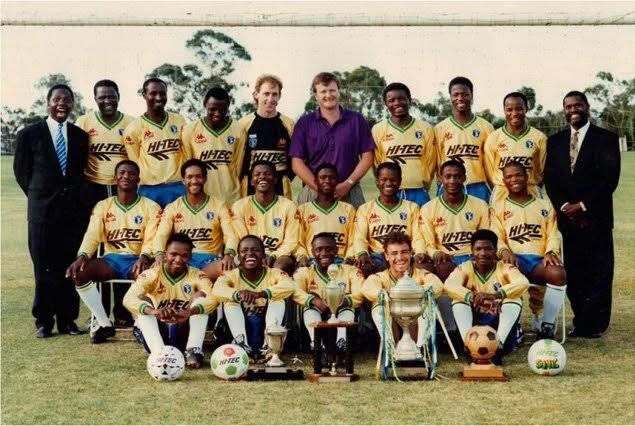
Before Mamelodi Sundowns became one of the most successful football clubs in Africa, there was a flamboyant businessman known as “Mr Cool.”
His name was Daniel Zola Mahobe.
Mahobe’s story is one of the most extraordinary chapters in South African football history. He arrived at Mamelodi Sundowns when the club was struggling, transformed its identity, attracted some of the country’s biggest football talent and helped turn the team into a powerhouse.
But behind the expensive cars, lavish parties, overseas trips and huge player salaries was a secret that would eventually destroy his football empire.
The money funding Mahobe’s extraordinary lifestyle had been stolen from Standard Bank.
This is the story of how a man who helped create the modern identity of Mamelodi Sundowns went from football’s ultimate showman to a convicted criminal whose empire collapsed almost overnight.
The rise of “Mr Cool”
Born in 1954, Mahobe came from humble beginnings in Soweto. Before becoming a wealthy businessman, he worked as a general worker and gradually built his business interests.
By the 1980s, however, his lifestyle had changed dramatically.
Mahobe had become known as “Mr Cool” and later “Mr Big Bucks”, names that reflected his larger-than-life personality and his willingness to spend money.
His biggest sporting investment came in 1985 when, at just 31, he acquired Mamelodi Sundowns.
At the time, Sundowns were nowhere near the dominant club South Africans know today. The club had struggled for years and had previously faced serious difficulties establishing itself at the top level.
Mahobe saw an opportunity.
And he didn’t intend to build an ordinary football club.
Mahobe turns Sundowns into the “Brazilians”
One of Mahobe’s most visible changes was the transformation of Sundowns’ identity.
He introduced the famous yellow and blue colours inspired by Brazil, helping establish the nickname “The Brazilians” that remains synonymous with the club today. Mamelodi Sundowns themselves credit Mahobe with playing a major role in the club’s rise during this period.
But the rebrand was only the beginning.
Mahobe spent heavily on players and coaches, offering salaries and incentives that were extraordinary for South African football at the time.
He appointed flamboyant coach Stanley “Screamer” Tshabalala, and under his leadership Sundowns developed the entertaining style that became known as “Shoe Shine and Piano.”
Mahobe wasn’t simply interested in winning football matches.
He wanted Sundowns to become a lifestyle.
Players were treated to expensive gifts, while Mahobe famously took the entire Sundowns playing group and their partners to London for the 1986 FA Cup final. The club’s own history records that he spent about R2 million strengthening Sundowns during his first two years of ownership.
For a footballer in 1980s South Africa, playing for Sundowns under Mahobe could feel like entering another world.
And then came the trophies
The spending wasn’t producing only headlines.
Sundowns started winning.
In 1986, the club claimed its first major cup after returning to the top flight, beating Jomo Cosmos 1-0 in the Mainstay Cup final.
The following year was even more remarkable.
Sundowns won the BP Top Eight, JPS Cup and Castle League Championship, establishing themselves as one of the country’s leading football clubs.
The transformation was extraordinary.
A club that had once struggled for survival was suddenly competing for major trophies and attracting some of the best talent available.
But while Sundowns were rising on the football field, a much darker story was developing behind the scenes.
The money behind the empire
Mahobe’s wealth eventually attracted the attention of investigators.
At the centre of the scandal was his girlfriend, Tebello “Snowy” Moshoeshoe, who worked as a teller at Standard Bank.
According to accounts of the case, Moshoeshoe used her position at the bank to move money into fictitious accounts connected to Mahobe.
The amount involved was enormous for the time.
Court proceedings later heard that 93 fraudulent transactions between 1983 and 1987 amounted to approximately R10.3 million.
That money helped finance the extraordinary lifestyle surrounding Mahobe.
Cars.
Businesses.
Luxury homes.
International travel.
And, crucially, Mamelodi Sundowns.
Contemporary reporting described Mahobe as living a champagne-filled lifestyle while his football empire expanded.
The contrast was staggering: while Sundowns were becoming a football powerhouse, the financial foundation supporting Mahobe’s empire was collapsing beneath him.
The escape to Botswana
Once the fraud was uncovered, the entire operation began to unravel.
Moshoeshoe was arrested, while Mahobe fled South Africa.
He eventually made his way to Botswana, where authorities tracked him down.
According to accounts of his arrest, Mahobe spent around nine months on the run before Botswana police arrested him and he was extradited to South Africa.
The man who had once walked into football stadiums surrounded by glamour was now facing a criminal trial.
The court case
Mahobe stood trial in 1988.
The prosecution presented evidence of the fraudulent transactions and the millions that had been moved from Standard Bank.
Mahobe pleaded not guilty and maintained that he had not known the money was stolen, claiming he believed it came from cattle sales connected to Moshoeshoe’s family in Lesotho.
The court rejected his defence.
On 12 January 1989, Mahobe was sentenced to 29 years in prison. He ultimately served 16 years, with the remainder suspended under conditions. Moshoeshoe also received a prison sentence.
The football empire he had built could not survive the scandal.
Standard Bank takes Sundowns
The consequences reached directly into football.
Standard Bank, which had suffered the losses from the fraud, repossessed Mamelodi Sundowns in 1988. The club’s own history records that Mahobe’s arrest created a crisis for the club and that the bank took ownership following the scandal.
Sundowns were now facing the possibility of collapse.
The club that Mahobe had transformed into one of South Africa’s most exciting teams was suddenly fighting for its very existence.
It was eventually rescued from liquidation when Angelo and Natasha Tsichlas, together with the Krok brothers, stepped in and negotiated with the bank.
That intervention helped preserve the club and allowed the Sundowns story to continue long after Mahobe’s era had ended.
The complicated legacy of Zola Mahobe
This is where Mahobe’s story becomes difficult to simplify.
It would be easy to remember him simply as a criminal who stole millions.
It would also be misleading to remember him only as the visionary who transformed Sundowns.
He was both.
His criminal activities funded an extraordinary football revolution, but the football success cannot erase the crime that financed it.
At the same time, it is impossible to tell the history of Mamelodi Sundowns without discussing Mahobe’s influence.
He helped establish the club’s famous Brazilian identity.
He introduced a culture of big spending and ambition.
He attracted major players.
He helped create the environment in which the “Shoe Shine and Piano” style flourished.
And he helped turn Sundowns into a club capable of challenging South Africa’s traditional giants.
The club itself acknowledges his role in the rise of Sundowns during the 1980s.
The story behind the story
What makes Mahobe’s story so fascinating is that it reflects more than football.
It is a story about money, ambition, crime, status and the complicated relationship between football and society in apartheid-era South Africa.
Mahobe became a symbol of conspicuous wealth at a time when opportunities were heavily restricted for the majority of South Africans.
His rise was spectacular.
His fall was equally dramatic.
After serving his prison sentence, Mahobe lived a much quieter life. He died on 14 December 2013, aged 59.
His story, however, did not disappear.
In 2022, authors Don Lepati and Nikolaos Kirkinis published The Legend of Zola Mahobe and the Mamelodi Sundowns Story, documenting the extraordinary rise and fall of the man who became one of the most fascinating figures in South African football history. The book was published by Tafelberg.
The man behind the modern Brazilians
Today’s Mamelodi Sundowns are almost unrecognisable compared with the club Mahobe purchased in 1985.
They have become a continental powerhouse with a global profile.
But long before the modern era of Patrice Motsepe, Champions League campaigns and African titles, there was Zola Mahobe.
He arrived with money, ambition and a vision for what Sundowns could become.
The tragedy is that the money behind that vision was stolen.
That is what makes the Mahobe story so uncomfortable — and so important.
He helped build a football institution that outlived him, but the empire that made him famous ultimately collapsed because of the very money that built it.
Zola Mahobe didn’t simply own Mamelodi Sundowns. For a brief and extraordinary period, he became the story of Mamelodi Sundowns.