Admin
Admin 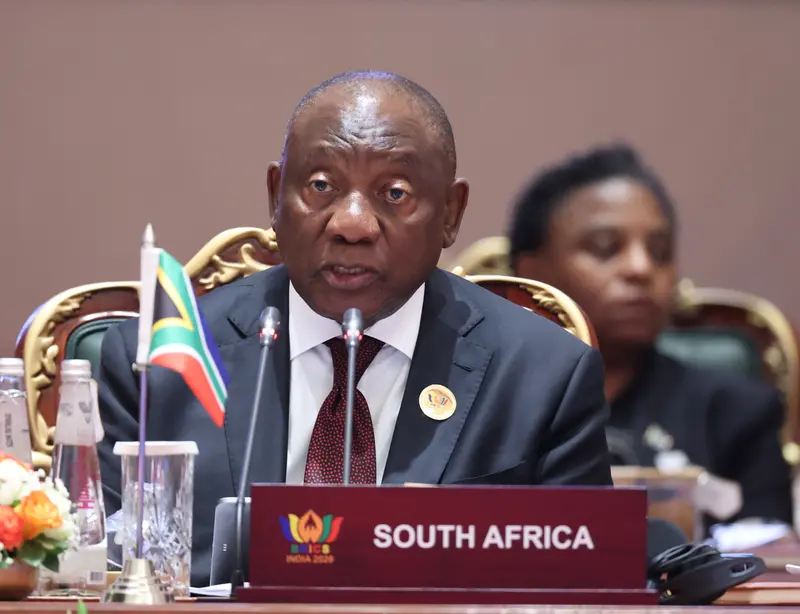
President Cyril Ramaphosa used the BRICS summit in New Delhi to make one of South Africa’s strongest recent arguments on the global stage: international law cannot be enforced against some countries while ignored when more powerful states are involved.
And at the centre of that argument was Gaza.
Speaking during a session on global governance and multilateralism at the 18th BRICS Leaders’ Summit, Ramaphosa warned that the authority of the United Nations and the international rules-based system was being weakened by open violations of the UN Charter and the increasing use of war to settle disputes.
But his message went further than a general defence of international law.
Ramaphosa demanded accountability for what he described as atrocities in Palestine, Sudan and Iran.
“To give strength to the law, there must be accountability for atrocities: for the ongoing genocide against the Palestinians, for the crimes committed against the people of Sudan and for the illegal war against Iran,” Ramaphosa told BRICS leaders.
His central argument was simple.
If international law is only applied when it is politically convenient, then it eventually loses its authority for everyone.
And in New Delhi, South Africa pushed that argument from principle towards a collective BRICS position.
Gaza becomes the test of “equal justice”
South Africa has spent much of the past three years arguing that the crisis in Gaza represents a major test for the international legal system.
The question, from Pretoria’s perspective, is not simply whether international law exists.
The question is whether the world’s most powerful institutions are willing to enforce it consistently.
That is why Ramaphosa’s remarks in New Delhi focused so strongly on the principle of equal application.
“International law cannot be applied selectively,” he said, arguing that the same principles and protections must apply to all states and all peoples.
For South Africa, Gaza has become the clearest example of that argument.
South Africa instituted proceedings against Israel at the International Court of Justice in December 2023, alleging violations of obligations under the Genocide Convention. Israel rejects the allegations.
The ICJ has issued provisional measures in the case, including measures relating to the prevention of acts prohibited under the convention and humanitarian assistance. The court has not yet delivered a final ruling on the merits of South Africa’s genocide allegation.
That legal distinction remains important.
But politically, South Africa’s ICJ case has already changed its role in the global debate.
Pretoria is no longer simply commenting on Gaza.
It has become one of the countries actively using international institutions to challenge what it sees as violations of international law.
BRICS put South Africa’s Gaza case into its declaration
Perhaps the most significant development from the summit was not Ramaphosa’s speech alone.
It was what BRICS agreed to collectively.
The New Delhi Declaration explicitly noted the provisional measures issued by the International Court of Justice in the case instituted by South Africa against Israel.
The declaration also referred to Israel’s legal obligation to ensure the provision of humanitarian assistance in Gaza.
That matters politically.
South Africa’s legal challenge, initially brought by Pretoria, is now being directly referenced in a declaration adopted by one of the world’s most influential groupings of emerging economies and Global South powers.
The declaration also took a strong position against the forced displacement of Palestinians.
BRICS leaders rejected attempts to permanently or temporarily displace Palestinians from occupied territory and opposed geographic or demographic changes to Gaza.
The document called for adherence to international humanitarian law and condemned violations including the use of starvation as a method of warfare, attacks on civilians and civilian infrastructure, and the obstruction of humanitarian access.
It also reaffirmed support for a sovereign and independent Palestinian state based on the internationally recognised 1967 borders, with East Jerusalem as its capital.
BRICS further supported full Palestinian membership of the United Nations.
A broader message: no country should be above the law
Ramaphosa’s argument was not limited to Gaza.
He linked Palestine to Sudan and Iran to make a broader point about how international law should function.
His position was that violations should be exposed and challenged regardless of who commits them.
“We must exert pressure and expose violations whenever, and by whomever, they are committed,” he said.
This is the principle South Africa is increasingly trying to place at the centre of its foreign policy.
The sovereignty and territorial integrity of states cannot matter only when certain countries are affected.
The prohibition against the use of force cannot depend on who launches the attack.
And the protection of civilians cannot be dependent on the geopolitical alliances surrounding a conflict.
In simple terms, South Africa’s message to BRICS was this:
The law must either apply to everyone, or powerful countries will eventually make the law meaningless.
Sudan and the demand for African solutions
The BRICS declaration also addressed Sudan’s devastating conflict.
The leaders called for an immediate and permanent ceasefire, unhindered humanitarian assistance and a peaceful political solution.
Importantly, the declaration supported the principle of African solutions to African problems.
That reflects a long-standing African Union position that conflicts on the continent should not simply become arenas where outside powers compete for influence.
For South Africa, this fits into the wider argument Ramaphosa was making.
International institutions should be strengthened.
But developing countries and regions should also have a greater role in shaping how their own crises are resolved.
Ramaphosa’s bigger target: a UN built for another era
Behind the Gaza issue was an even larger argument about global power.
Ramaphosa said the United Nations was being pushed towards irrelevance because the rules it was built to enforce were increasingly being ignored.
At the same time, he argued that the institution itself needed major reform.
Africa remains at the centre of that argument.
The continent has 54 member states at the United Nations and represents nearly one-fifth of the world’s population.
Yet Africa has no permanent representation on the UN Security Council.
“This is neither just nor sustainable,” Ramaphosa said.
South Africa has repeatedly called for comprehensive Security Council reform that would make the body more representative, transparent, accountable and effective.
The New Delhi Declaration recognised Africa’s demand for greater representation and referred to the continent’s common position contained in the Ezulwini Consensus and Sirte Declaration.
For Ramaphosa, this is directly connected to the question of Gaza.
If the countries most affected by global decisions have limited influence over the institutions making those decisions, then the system will continue to face questions about legitimacy.
BRICS as a political bridge
The challenge for BRICS is that its members do not agree on everything.
The expanded grouping includes countries with different political systems, regional rivalries and competing relationships with major global powers.
That makes unanimous action difficult.
But it is also why Ramaphosa described BRICS as potentially important in a fragmented world.
“In a fragmented world, dialogue matters more than confrontation,” he said.
The New Delhi summit showed the grouping trying to find common language despite those differences.
The declaration called for dialogue, diplomacy, restraint and respect for sovereignty as tensions continued across the Middle East and other parts of the world.
Whether BRICS can translate those statements into real geopolitical influence remains a separate question.
But the bloc is becoming increasingly important as countries in Africa, Asia and Latin America demand a greater role in global decision-making.
More than a speech
It would be easy to view Ramaphosa’s intervention as another strong speech on Gaza.
But the more important development may be what happened after the speech.
South Africa’s core argument appeared in a wider BRICS framework.
The New Delhi Declaration referred to the ICJ provisional measures in South Africa’s case.
It called for humanitarian access.
It opposed forced displacement.
It condemned starvation as a method of warfare and attacks on civilians and civilian infrastructure.
And it reaffirmed support for Palestinian statehood and full UN membership.
That gives South Africa something more than a moral position.
It gives Pretoria evidence that its argument has gained support inside a major international grouping.
The risk of selective justice
The strongest part of Ramaphosa’s message was ultimately a warning.
International law cannot survive on paper alone.
It survives because countries believe the rules apply to everyone.
When powerful states are seen as capable of ignoring those rules without consequences, other states have less reason to respect them.
That is the danger Ramaphosa was describing.
The issue is bigger than Palestine.
It is about whether the international system created after the Second World War can still command legitimacy in a world where power is increasingly shifting away from the traditional Western centres of influence.
South Africa’s answer is clear.
The world does not need fewer international rules.
It needs rules that are applied equally.
And at the BRICS summit in New Delhi, Ramaphosa placed Gaza at the centre of that argument.
The message was directed at the international community, the United Nations and the world’s major powers.
No country should be protected by the law only when it is politically convenient.
And no country, Ramaphosa argued, should be powerful enough to act with impunity.